Translating the same paragraph into English or Spanish completes only one part of a multilingual website. A site that can be used, searched and maintained also needs URL structure, page relationships, language switching, search signals and an update process.
When these decisions are left until later, language switches often return visitors to the homepage, search results show the wrong language, or one version stops being maintained.
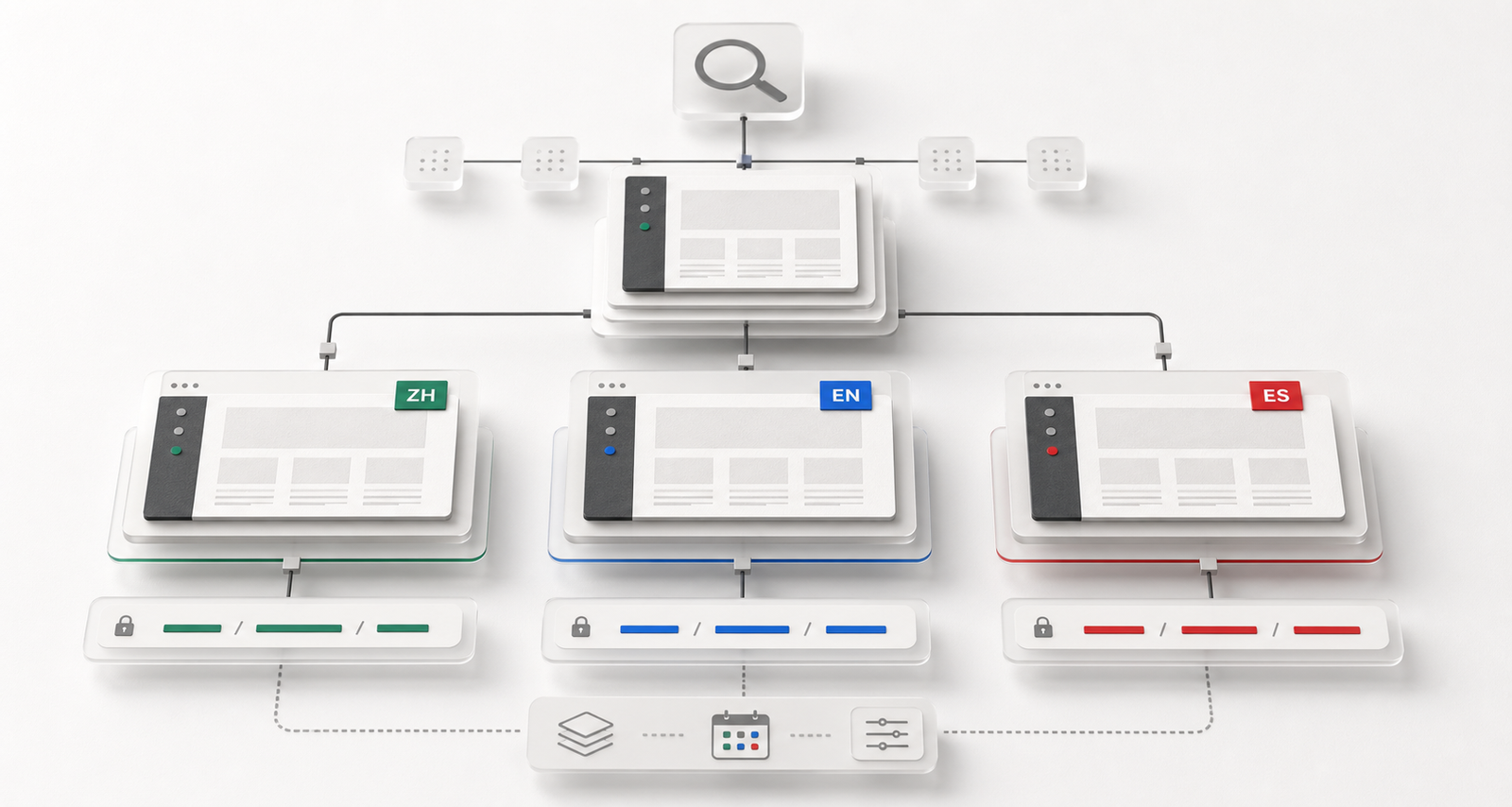
Give every language a dedicated URL
Each language version should have an address that can be opened and shared directly, for example:
- Chinese:
/services/ - English:
/en/services/ - Spanish:
/es/services/
Do not rely only on browser storage or replace text at one URL. Dedicated URLs let users bookmark the right version and help search engines understand and index it.
Once the structure is set, redirect old URLs and query-parameter versions so that the same content does not remain indexable at several addresses.
Keep the current page when switching languages
When a visitor selects Spanish from an English service page, they should reach the equivalent Spanish service page, not the Spanish homepage.
The system therefore needs a relationship between language versions. If one translation does not exist, decide whether to show the source language, hide that option or return to the relevant content list. Do not send users to a missing page.
Use hreflang to express language relationships
Each page can use hreflang links to identify its corresponding Chinese, English and Spanish versions, plus a default version.
The relationships must be reciprocal and every URL must work. If one page references another language but is not referenced back, search engines may not trust the relationship.
Let canonical point to the current language
Different languages are not duplicate pages. An English page should normally have a canonical link to itself, and a Spanish page should do the same. Their relationship is then expressed with hreflang.
If every language points its canonical to Chinese, search engines may retain only the Chinese URL, making the other versions less likely to appear in the correct markets.
Localise for context, not word by word
Literal translation can be correct but unnatural. Service names, calls to action, address formats, currencies, dates, payment methods and common questions should match local expectations.
Keywords also require local research. Different markets may use different phrases for the same service, so titles, descriptions and body copy should be reviewed in each language.
Share structure while keeping content independent
A practical content model lets one article share its slug, category, cover, status and publication time while each language has its own title, excerpt, body and SEO description.
Editors can see whether all languages are complete without creating three unrelated records. If a translation is unfinished, keep it in draft rather than publishing an empty or automatic placeholder.
Assign ongoing ownership
Before launch, answer:
- Which pages must always remain aligned in all languages?
- Who translates and reviews new articles?
- Who checks other languages when a service or policy changes?
- How often are broken links and outdated content reviewed?
- Is search performance reviewed by language or by market?
The cost of a multilingual site is not limited to its first translation. It appears again whenever content changes. Clear ownership and completion criteria prevent one language version from gradually becoming inaccurate.
Turn translation into a traceable publishing flow
Do not use only “translated” and “not translated” as content states. A more reliable process can include:
- Source content and business facts confirmed
- Translation completed with approved terminology and brand voice
- Reviewed by a native speaker or someone familiar with the market
- Titles, search descriptions, links and calls to action checked
- Layout, forms and language switching verified in a test environment
- Published with a recorded last-review date
Store the content owner, translator, reviewer and next review date as well. When prices, service coverage, legal terms or contact details change, the team can identify every page that needs to be updated.
Measure each language and market separately
Combining all traffic in one report can hide a weak language version. Track at least:
- Indexed pages and search impressions
- Clicks from branded and non-branded queries
- Visit quality from priority countries or cities
- Exit behaviour after language switching
- Enquiry, booking or purchase completion
- Update frequency for each language
Lower traffic does not automatically mean the translation failed. Market demand, domain authority and content volume may differ. First confirm that the pages can be indexed, then review whether search terms match local usage, and finally assess whether the page supports the business outcome.
A practical troubleshooting order
If search results show the wrong language, check whether URLs are unique, canonicals point to themselves and hreflang is reciprocal. If switching returns to the homepage, inspect page relationships and the missing-translation rule. If one language stays outdated, fix ownership and review reminders rather than only adjusting the interface.
Investigating in the order of URL and indexing, page mapping, content quality and operational ownership usually finds the cause faster than changing every SEO tag at once.
Technical checks before launch
Confirm that every language has:
- A unique URL that opens directly
- The correct document language
- Its own page title and search description
- A self-referencing canonical
- Complete reciprocal hreflang links
- A language switch that preserves the current page
- Production URLs in the sitemap
- No accidental
noindexdirective
A multilingual website is not three disconnected copies. It gives several markets access to one brand system while presenting information that fits each audience. Technical structure and content operations must be designed together to keep every version credible, searchable and maintainable.