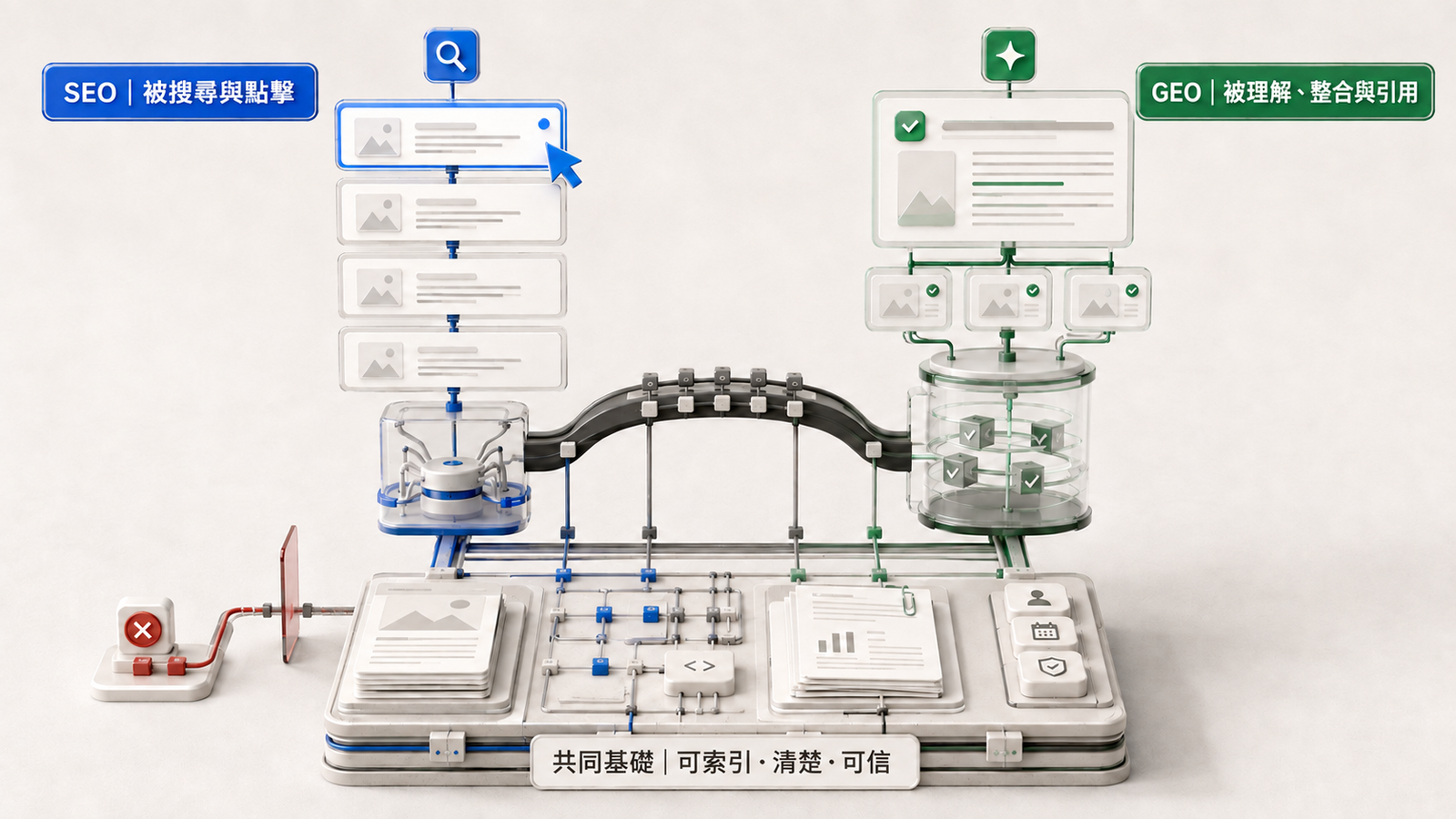
The simplest distinction is this: SEO helps a website appear in conventional search results and earn clicks; GEO helps its content be understood, verified, combined and cited inside generative answers.
They are not alternatives. A website with unstable URLs, blocked pages, inaccessible text or weak evidence is unlikely to gain reliable generative visibility by adding a few “AI-optimised” paragraphs. The practical order is to establish sound SEO and content foundations, then make answers easier to extract and verify through direct conclusions, context, evidence, authorship, update records and measurement.
GEO stands for Generative Engine Optimization. It is a term used in research and industry, not a guaranteed ranking programme offered by one platform. Google states that pages appearing in its AI search features must still be indexed and eligible for regular search results. Established SEO practices remain relevant, and no special markup guarantees inclusion.
SEO and GEO at a glance
| Area | SEO | GEO |
|---|---|---|
| Primary goal | Make a page crawlable, indexable, rankable and capable of earning organic clicks | Make information easier for generative systems to understand, verify, summarise and cite |
| Common output | Search listings, featured results, image or video results | AI summaries, conversational answers and recommendations with sources |
| Main unit | Page, query, ranking and click | Question, answer passage, entity, evidence, source and context |
| Technical foundation | HTTPS, HTML, internal links, canonical, sitemap, mobile usability and performance | The same SEO foundation plus clear answers, verifiable facts and consistent structure |
| Content focus | Search intent, topic completeness, hierarchy and readability | Answer first, then conditions, examples, comparisons, sources and limitations |
| Common metrics | Impressions, rankings, clicks, organic traffic and conversion | AI referrals, cited pages, brand mentions, CTA use and qualified enquiries |
| Main limitation | Ranking does not guarantee a sale | A citation may be unstable, inaccurate or commercially irrelevant |
In practice, this is one publishing discipline rather than two disconnected programmes. A well-structured article with an explicit answer, useful evidence and relevant internal links is generally better for readers, search engines and generative systems.
What does SEO solve?
SEO begins with reliable access, not keyword repetition:
- Discovery: important pages have stable URLs, internal links and accurate sitemap entries.
- Understanding: essential text exists in readable HTML, while headings, paragraphs, image alternatives and structured data agree.
- Version control: canonical links, redirects, language URLs and hreflang identify the correct version.
- Quality: the page genuinely satisfies a need instead of repeating terms, publishing thin promotion or creating many near-duplicates.
- Action: after arriving, a visitor can reach a service, case study, contact path or useful next step.
SEO therefore involves more than a position on a results page. Security, speed, mobile usability, durable URLs, migration redirects and the business journey all affect whether search visibility creates value.
What does GEO add?
A generative experience may not return only a list of links. It can break a question into subtopics, retrieve several sources and compose an answer. GEO pays particular attention to whether a page can be extracted without losing meaning.
Content that is easier to understand and cite usually:
- answers the main question near the beginning;
- states suitable and unsuitable conditions;
- uses steps, comparison tables, checklists or genuine cases;
- identifies sources, update dates and content ownership;
- keeps brand, service and contact facts consistent;
- separates confirmed facts, advice, inference and unknowns;
- uses complete contextual sentences rather than keyword fragments;
- links to deeper services, evidence and related explanations.
The goal is not to write for machines at the expense of people. It is to make the page easy for both to assess: what is being answered, what supports the conclusion, when the conclusion changes and where to verify it.
Why GEO cannot bypass SEO
If a page is blocked, marked noindex, assigned the wrong canonical, dependent on interaction before its essential text appears, or mixed with conflicting language URLs, generative search has no dependable source. For Google's AI search features, official guidance says a page must remain indexed and eligible for a normal search result.
A business should therefore complete the shared foundation before looking for AI-specific shortcuts:
- production HTTPS and durable URLs;
- important information directly available in HTML;
- correct robots rules, sitemaps, canonicals and redirects;
- separate Chinese, English and Spanish URLs with
langand hreflang; - a clear boundary between public pages and private administration;
- structured data limited to visible and verified claims;
- understandable and usable mobile layouts;
- sitemap or IndexNow notifications for meaningful changes where supported.
IndexNow can tell participating search engines that a URL was added, updated or removed. An HTTP 200 response confirms receipt of the notification; it does not promise indexing, ranking or an AI citation.
How can one page support both SEO and GEO?
Consider an article answering “Does a company website need a CMS?” A weak introduction might say:
We provide the most professional CMS websites with powerful features and competitive prices. Contact us today.
It offers no decision criteria. A reader or generative system cannot determine when a CMS is actually appropriate.
A stronger opening would be:
A CMS is usually worth planning when non-developers must regularly update articles, cases, campaigns or multilingual content, especially when drafts, review and publishing permissions are required. If the website changes once a year and a technical owner handles the few updates, a simpler static implementation may be more appropriate.
The page can then cover suitable and unsuitable cases, roles, draft and review states, multilingual URL management, backups, handover, practical scenarios and FAQs. This provides search intent, a direct answer, conditions and self-contained passages without repeating “CMS website” throughout the page.
Nine practical steps for a business website
1. Confirm that public pages are indexable
Use Google Search Console, Bing Webmaster Tools and actual HTTP responses. A page opening in a browser does not prove that a search engine can index the intended version.
2. Give each page one primary question
A broad services page can introduce several capabilities, but each article needs a defined problem. Avoid forcing pricing, CMS, ecommerce, SEO and brand design into one page.
3. Put the direct answer first
State the conclusion in the first one or two paragraphs, then explain it. Readers do not have to cross a long promotional introduction, and summaries are less likely to omit the main qualification.
4. Publish conditions, not only benefits
Explain who a solution fits, who it does not fit, which prerequisites matter and what limitations apply. Trustworthy advice does not route every situation to the same product.
5. Add verifiable evidence
Use official documentation, primary research, genuine experience, an explainable method or authorised case material. Do not invent percentages, testimonials, rankings or outcomes.
6. Maintain a public facts record
Keep the company name, services, website, contact channel and approved cases consistent. Unconfirmed legal names, addresses, phone numbers, service areas or profiles should not be added to schema.
7. Use controlled structured data
Apply Organization, WebSite, Service, Article, CreativeWork, BreadcrumbList or FAQPage when the visible page supports it. Structured data is not a ranking promise and must not describe invisible or fabricated claims.
8. Build meaningful internal links
Connect an article to the relevant service, case and next explanation. This supports a reader's decision and helps systems understand topic relationships.
9. Measure the full path to an enquiry
Do not stop at a brand mention. Review search impressions and clicks, AI referrals, page views, CTA use, submitted enquiries and whether those enquiries are qualified.
Practices that look like GEO but create risk
- Generating hundreds of similar articles without responsible review.
- Creating thin city or service pages solely to capture variations of a query.
- Publishing FAQ schema when the same questions and answers are not visible.
- Inventing statistics, expertise, citations, customers or testimonials.
- Switching three languages on one JavaScript URL without indexable language routes.
- Hiding sentences intended only for a crawler or AI system.
- Treating search access and model-training permission as the same policy.
- Promising a ChatGPT citation or first-page ranking within a fixed period.
- Counting a brand mention without checking accuracy, referral traffic or business action.
Google's guidance for generative AI content remains centred on usefulness. Producing pages at scale without user value can fall under scaled content abuse. AI can assist research, organisation and drafting, but people remain responsible for facts, perspective, permission and publication quality.
How should performance be measured?
Use four levels rather than one headline metric:
| Level | Observable data | Question |
|---|---|---|
| Discoverability | Indexed URLs, sitemap status, crawling and technical errors | Can systems find the correct public page? |
| Search performance | Impressions, queries, ranking ranges and organic clicks | Which questions produce real search visibility? |
| AI visibility | AI referrals, cited pages, fixed-question checks and brand mentions | Which platforms and questions mention or cite the site? |
| Business result | CTA use, submitted enquiries, qualified enquiries and follow-up | Does the visit create an opportunity worth handling? |
Generative answers may change with platform, model, date, location, language and login state. One citation is an observation, not a stable ranking. A better review uses the same questions and recorded conditions each month, then compares those samples with real referrals and enquiries.
How do SEO, AEO and GEO relate?
The terms overlap in practice:
- SEO creates a crawlable, understandable and indexable site that satisfies search intent.
- AEO structures content to answer questions directly, including FAQ, summary, voice and answer-style experiences.
- GEO considers how generative systems retrieve several sources, preserve context, form an answer and attach citations.
A business does not need a separate team for every acronym. One workflow can combine technical SEO, answer-first content, trustworthy evidence and generative visibility measurement.
Frequently asked questions
Does GEO replace SEO?
No. GEO generally relies on the crawlability, indexing, clarity and trust established through SEO. Without those foundations, systems have difficulty finding the correct version consistently.
Is llms.txt required for AI discovery?
It currently does not replace robots rules, sitemaps, normal HTML, canonicals, structured data or content quality. Businesses can monitor developing conventions without treating the file as a required or guaranteed shortcut.
Does using AI to write content harm SEO?
The tool alone is not the deciding factor. Risk comes from publishing inaccurate, repetitive or low-value material at scale, especially to manipulate rankings. AI can support a draft, but a person should verify facts, add genuine experience, set the position and approve publication.
Will JSON-LD make an AI cite the page?
No. Correct structured data can clarify entities and page types, but content must still be visible, accurate, consistent and eligible. There is no schema that guarantees a citation.
How can we tell whether AI produces customers?
Identify observable AI referrals and follow the landing page, CTA and enquiry source. For answers that do not produce a click, complement this with available Bing citation data and a fixed-question review. Neither data source replaces the other.
Conclusion: build a trustworthy site, then a citable answer
SEO addresses whether search systems can discover, understand and present a website. GEO focuses on whether content can be correctly extracted, verified and cited in a generative response. The effective approach is not to chase acronyms, but to build a repeatable publishing process: durable URLs, correct indexing, direct answers, decision criteria, real evidence, multilingual consistency, clear updates and meaningful measurement.
Start with three questions that customers repeatedly ask near a service decision. Give each question a complete page, then review indexing, internal links, citations and enquiries before producing more content.
Continue with multilingual website URLs, SEO and content management and the seven inputs to prepare before planning a business website. You can also review our services or start a project with your current website, customer questions and search or content priorities.
Sources
- Google Search Central: AI features and your website
- Google Search Central: Optimizing your website for generative AI experiences
- Google Search Central: Guidance on using generative AI content
- GEO: Generative Engine Optimization
- IndexNow documentation